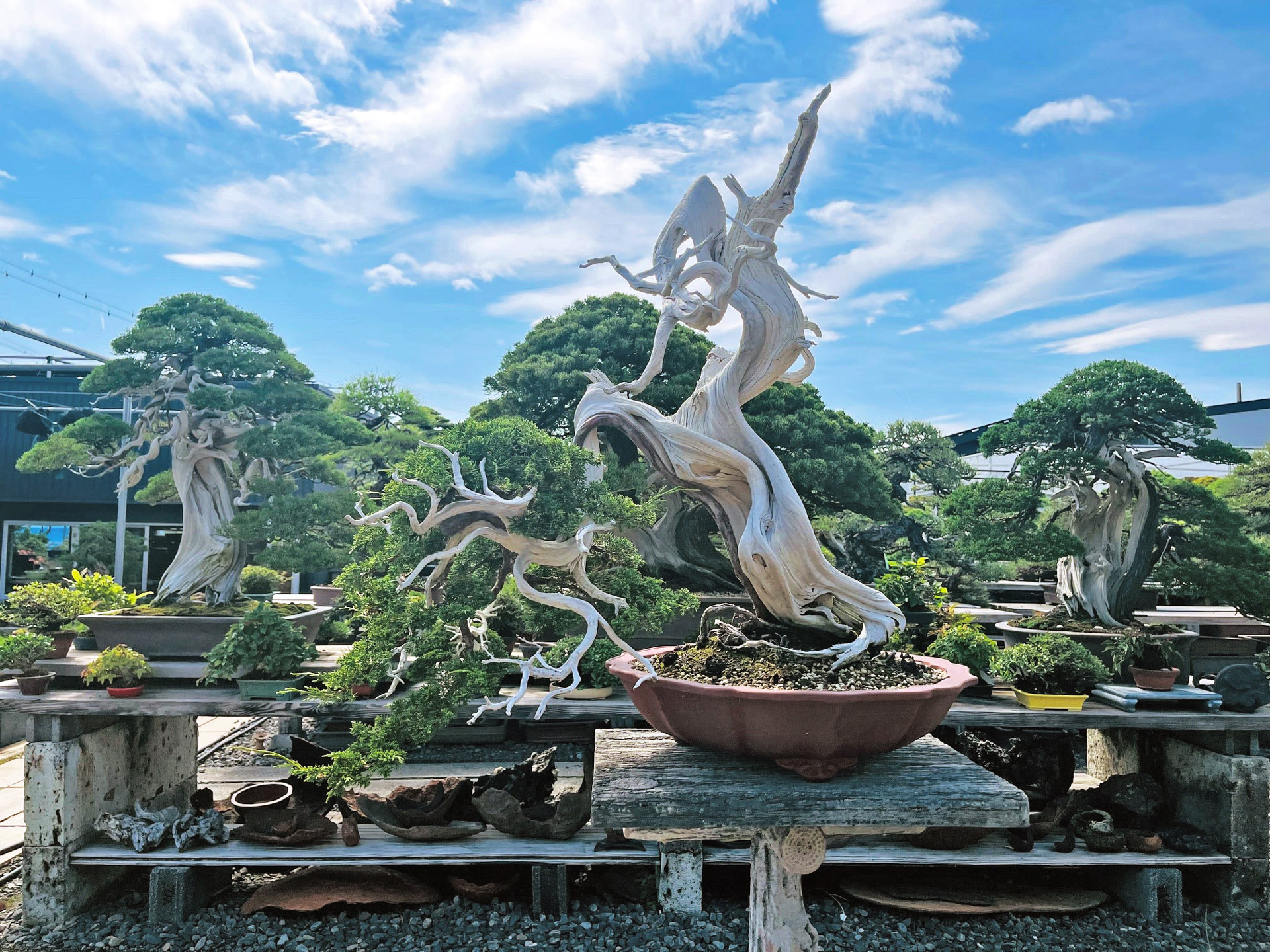
Paolo Nastasi's obsession for improvement made him travel to Japan
‘Ganbatte’ means do your best, the best you can, don’t give up, go for it. It’s almost like a tantra in Japan. During Paolo Nastasi’s many travels to Urushibata’s nursery, he became even more motivated to practise Ganbatte.
For about ten years, I have been dedicating a couple of months a year to improving my bonsai background, thanks to study trips to Japan in the prefecture of Shizuoka and, more precisely, to the Taisho-En of Master Taiga Urushibata. The Taisho-En is an oasis of wonderful living works of art; this garden was the first to open its doors to foreign students wishing to do short-term apprenticeships because, in traditional manner, bonsai Masters only accepted apprenticeship with a very strict hierarchic system.
Taisho-En was the precursor leading to a huge improvement in the European bonsai level and from here came names who became important artists, such as Mario Komsta and Manuel Germade, initially Deshi and, after five to six years of apprenticeship, Masters. In addition, numerous foreign students or Gakusei conducted short periods of study there, becoming highly valued instructors.
During these years, I have also had the opportunity and honour to study with Taiga San’s father, Master Nobuichi Urushibata, a great Master and wonderful person who has left indelible memories and teachings. In my journey, I have taken the opportunity to work with exemplary professionals and this has contributed to my training and personal improvement as an ‘artist’ and man as well.
I am most grateful to have begun my journey with Salvatore Liporace, undoubtedly the best Italian bonsaist of the last thirty years. I believe that a good instructor must first and foremost be a good student, always active in his studies and with a marked and inexhaustible curiosity.

The Taisho-en is like a big family, an ideal place for serenity and peace of mind
Paolo Nastasi
What does being there mean to me?
Working every day to try to do better than the day before, with a greater dose of commitment and dedication to expand fundamental elements: training, practice and technique. Reaching a level where attention to detail and creativity never seem to run out. Initially, during my training, I thought that cultivation and restyling were cornerstones to creating a fine plant. With the passing of the years, I realised that daily maintenance is the fundamental aspect of accomplishing quality bonsai. The balance of the foliage and short branching is the primary goal to achieve, and this is done by careful pruning to balance the tree’s strengths.
Every trip to Japan is an enlightenment, an opening of the mind. During my last stay, in June 2024, I had the opportunity of working on Todoroki — in Japanese it means ‘roar that precedes a great earthquake’. It is the name of a splendid Akamatsu red pine (Pinus densiflora) that, in 2019, won the Prime Minister Award at the Sakufu-ten, the highest recognition for a professional Master.
June is par excellence, the so-called month of Mekiri that involves improving the branching of pines, obtaining small needles and balancing the vegetative strength of the tree. This also means you have to learn how to make a judicious selection of the needles. Aiming for a crown with short internodes, which will also allow the usage of less wire, because as the branches lignify they will tend to go upwards, in search of the sun. I’ve used this technique with my sylvestris pines for a long time, obtaining great results.
Master Taiga tends to vary the work every day to improve the student’s mental elasticity and prevent us from becoming robots. Contrary to what one might think, the work during summer is very intense and varied. The most important aspects are pruning and cleaning trees. When I was entrusted with pruning a Japanese maple (Acer palmatum), I learned a new technique, developed by 0yakata (Father Urushibata).
Called Hagiri, which is the partial cutting of the leaves or the whole leaf, except for leaf stalks, to direct the energy towards the basal buds, allowing a better passage of light and air inside the branching, improving photosynthesis. We had the opportunity of grafting a rigida juniper with Itoigawa foliage in June. But first Taiga gave an analysis of all aspects of the tree, from the front to positioning scions and lymph flow. The knowledge and mastery of Taiga that was developed over time, allowed many specimens to be changed, improving the quality and strength of the tree.

Master Taiga varies the work every day to improve the student's mental elasticity
Paolo Nastasi
Bonsai making is an art, it allows you to create a synergy with a living being, to experience unique emotions, to grow by challenging yourself daily and sometimes it is a comfort in dark times. The creation of bonsai is the breath of the soul.