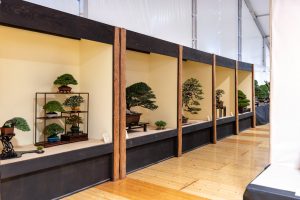
The world of bonsai is truly strange; it becomes all-consuming for those who embrace this passion wholeheartedly. Bonsai enthusiasts often harbour a desire to live and surround themselves with master piece bonsai. Salvo Amato has this same desire, but found a rather unfamiliar solution, aluminium wire bonsai. How did he come up with this original idea. Gaetano Conte (intitiator of Kifu Bonsai Awards) visited him to find out.
Salvo Amato, a sculptor of aluminium-wired bonsai, can boast of having one of his creations at Masahiko Kimura’s studio. His adventure into bonsai began like so many others: 20 years ago, for the Christmas holidays, he was given a bonsai from a market stall. He sought out another one at a nursery, and that was his first contact with other bonsai enthusiasts, which has led him to now possess a respectable collection of well-matured plants, generally of the ippan size (aprox 45 – 100cm).
How did you come up with the idea of making miniature aluminium bonsai?
About eight years ago, whilst browsing social media in search of trees to study, I was literally blown away by a Spanish artist named Raul Fernandez, who created miniature bonsai using copper and/or aluminium wire. The beauty of those tiny works of art initially convinced me to try and replicate Fernandez’s techniques by studying the photos of his work I found online.
One of the few 1.5mm aluminium bonsai: difficult to work with, but it allows you to create larger pieces.
The idea that these small creations, measuring around 13–15 cm, could represent an ‘immortal’ bonsai – that they were the solution for having a little tree in any corner of the house – began to grow stronger and more intriguing. Indeed, over the years, bonsai enthusiasts often change the shape of a bonsai, whether out of necessity or personal taste: the aluminium reproduction ‘captures’ a precise moment in the plant’s life, thus making it ‘immortal’.
However, I think the appreciation for my work came when I began to reproduce very famous bonsai. Working with copper first and then aluminium captivated me to such an extent that I found my own personal way of crafting these small sculptures.
The solution for having a little tree in any corner of the house
Have you had, or do you still get, a lot of requests for these small sculptures?
My sculptures have certainly found their way to Spain, Germany, England and the United States, as well as Italy. Thanks to a friend, one of my aluminium bonsai is still in the studio of master Masahiko Kimura.
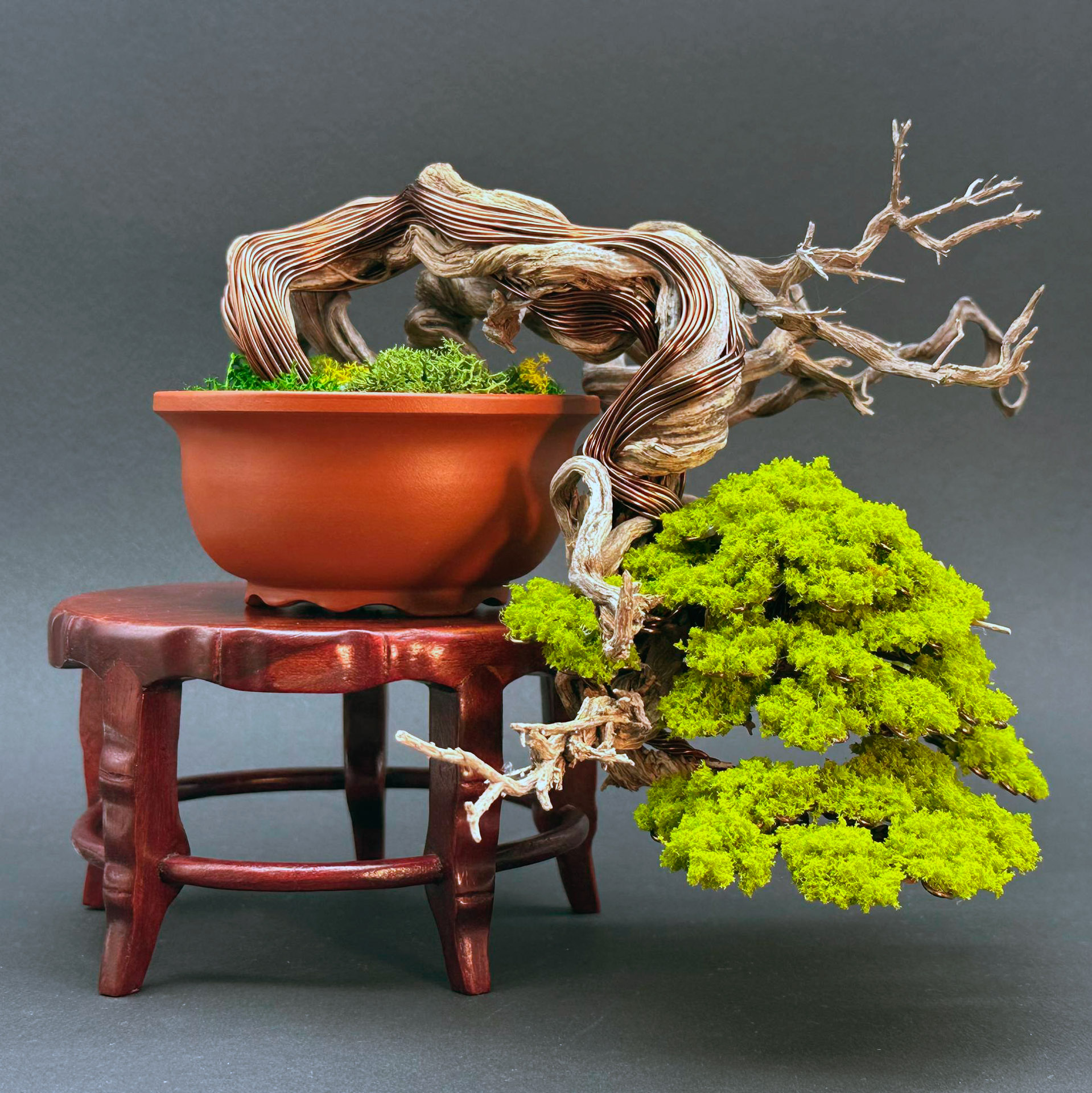
What makes my works particularly original today is what Fernandez, now a friend of mine, called ‘la dedicación’: dedication! Over time, and with improved manual dexterity, I also incorporated pieces of dry wood (mainly thyme), seeking to breathe new life, into what was dead.
Later on, as often happens with many bonsai enthusiasts, I began to take an interest in Japanese pots for my collection of trees, and this also led to greater care in matching the pots to my small creations. I make no secret of the fact that many are signed by renowned potters from Tokoname and Seto.
The piece currently on display in Master Kimura’s studio in Japan.
When creating an aluminium-wire bonsai, where do you start?
The idea always comes from images, from photos. I print out the photo or sketch the branches of a bonsai on a sheet of paper, and that’s where the calculations begin. Nothing is left to chance; there is no improvisation: I calculate the number of wires and their length (which also depends on the movement the wire will make). I often ‘multiply’ the end numbers: I start with 100 wires, for example, which can end up being as many as 300. By studying images sent from Japan, I arrived at these multiplicative solutions.
Aluminium and wood with soft plastic finishes that make the sculpture look very lifelike.
In almost 8 years, I have created more than 280 pieces...
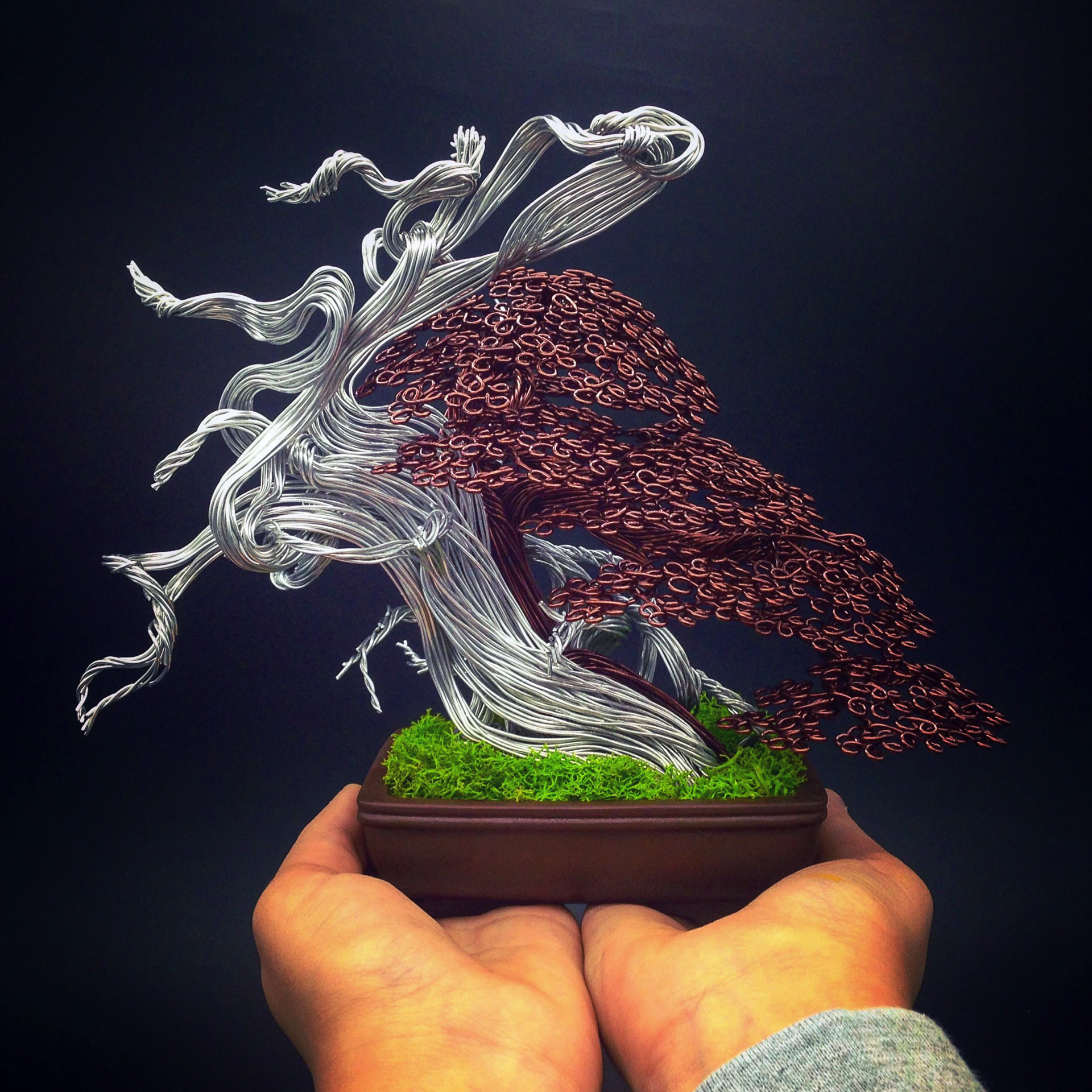
The artist’s preferred technique. It begins with the interweaving of two shades of aluminium. The time taken to complete the piece varies from a few hours to 20 hours of work.
Which materials do you find easiest to work with, and in your experience, what are the best wires to use?
I started with copper, but it was difficult to find it in the right gauge. It made my hands too dirty, and the residue left behind during the work was a nuisance. Aluminium is definitely the best material: it’s more malleable, clean to work with, lightweight and comes in different colours. The gauge ranges from 1mm to 1.5mm. My favourite is 1.2mm. I often combine the 1mm silver colour (for the deadwood parts) with the 1.2mm copper-coloured wire for the rest (veins and foliage).
One the most real like reproductions ever created for a renowned Italian bonsai master.
The real bonsai.
Do you have some advice to who, like you, has just decided to start creating these sculptures?
The beginning is always marked by failures, by disproportionate pieces, by approaches that are, shall we say, ‘Taiwanese’ in style: the result is a far cry from the true representation of a bonsai. Only with patience and study (I have analysed dozens of photos hundreds of times), combined with the determination to succeed, can one achieve a reasonable degree of success: never settling for less could lead to success.
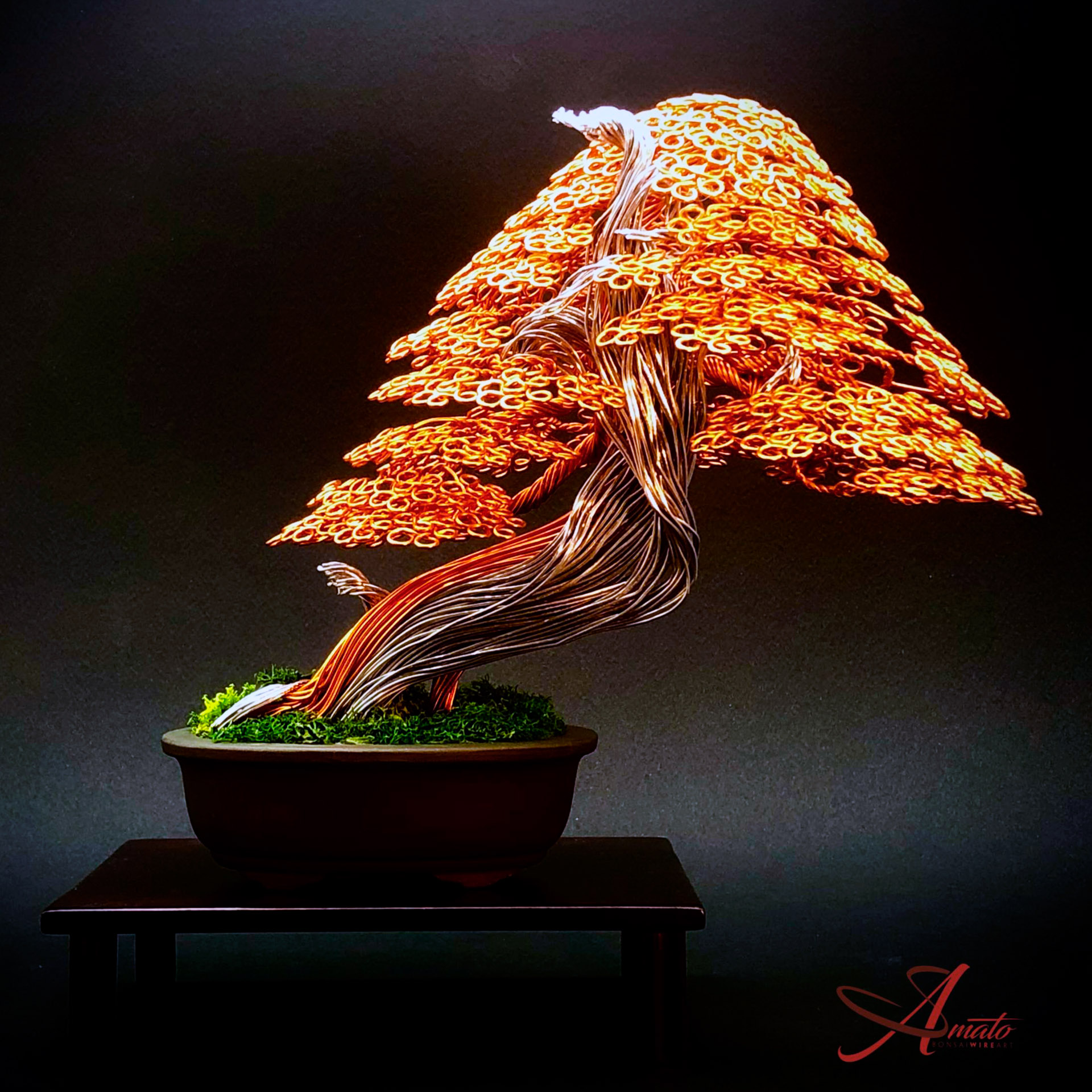
One of the few pieces still in Salvo Amato’s studio.
Wooden version: 1mm aluminium was used, which is very pliable to follow the curves of the wood.
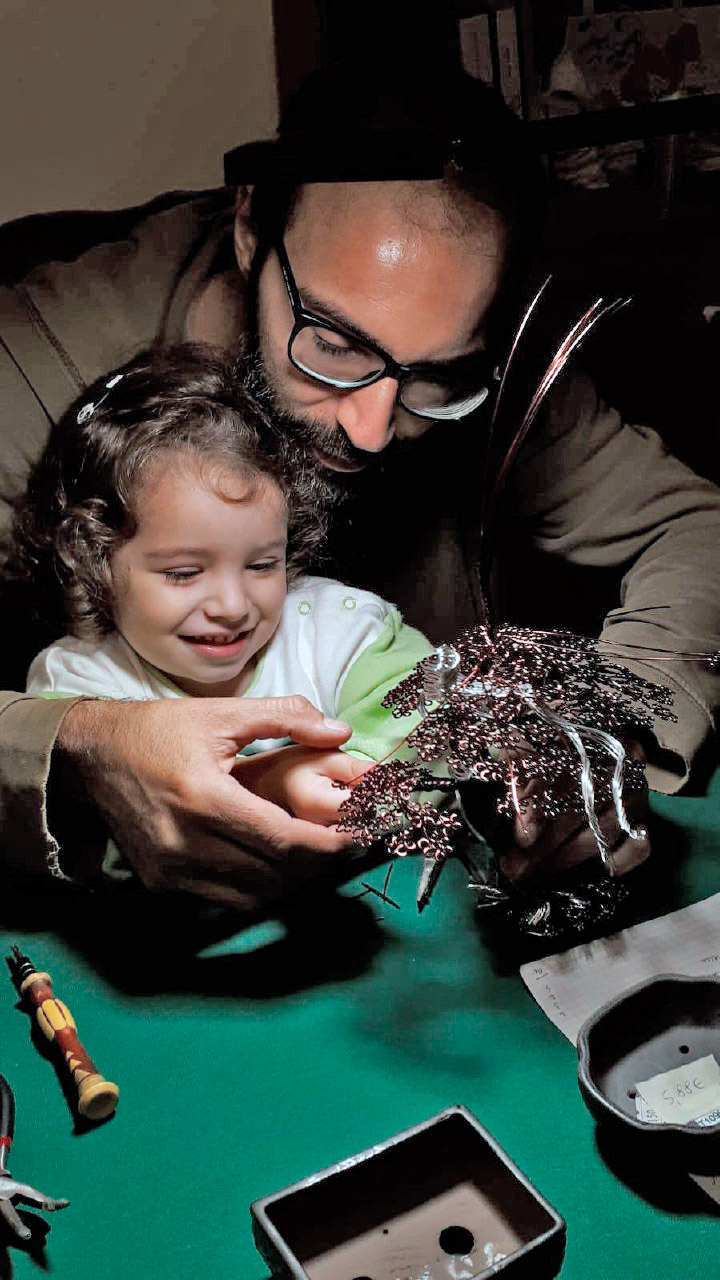
With the green aluminium headband. The brown and green weave is practically invisible.
We use cookies on our website to give you the most relevant experience by remembering your preferences and repeat visits. By clicking “Accept”, you consent to the use of ALL the cookies.
This website uses cookies to improve your experience while you navigate through the website. Out of these cookies, the cookies that are categorized as necessary are stored on your browser as they are essential for the working of basic functionalities of the website. We also use third-party cookies that help us analyze and understand how you use this website. These cookies will be stored in your browser only with your consent. You also have the option to opt-out of these cookies. But opting out of some of these cookies may have an effect on your browsing experience.
Necessary cookies are absolutely essential for the website to function properly. This category only includes cookies that ensures basic functionalities and security features of the website. These cookies do not store any personal information.
Any cookies that may not be particularly necessary for the website to function and is used specifically to collect user personal data via analytics, ads, other embedded contents are termed as non-necessary cookies. It is mandatory to procure user consent prior to running these cookies on your website.
Send me the newsletter.
You can cancel your Bonsai Today membership at any time, and you will continue to have access to Bonsai Today through the end of your billing period. To cancel, go to the ‘Members‘ page and click on ‘Cancel‘ in My Memberships.