
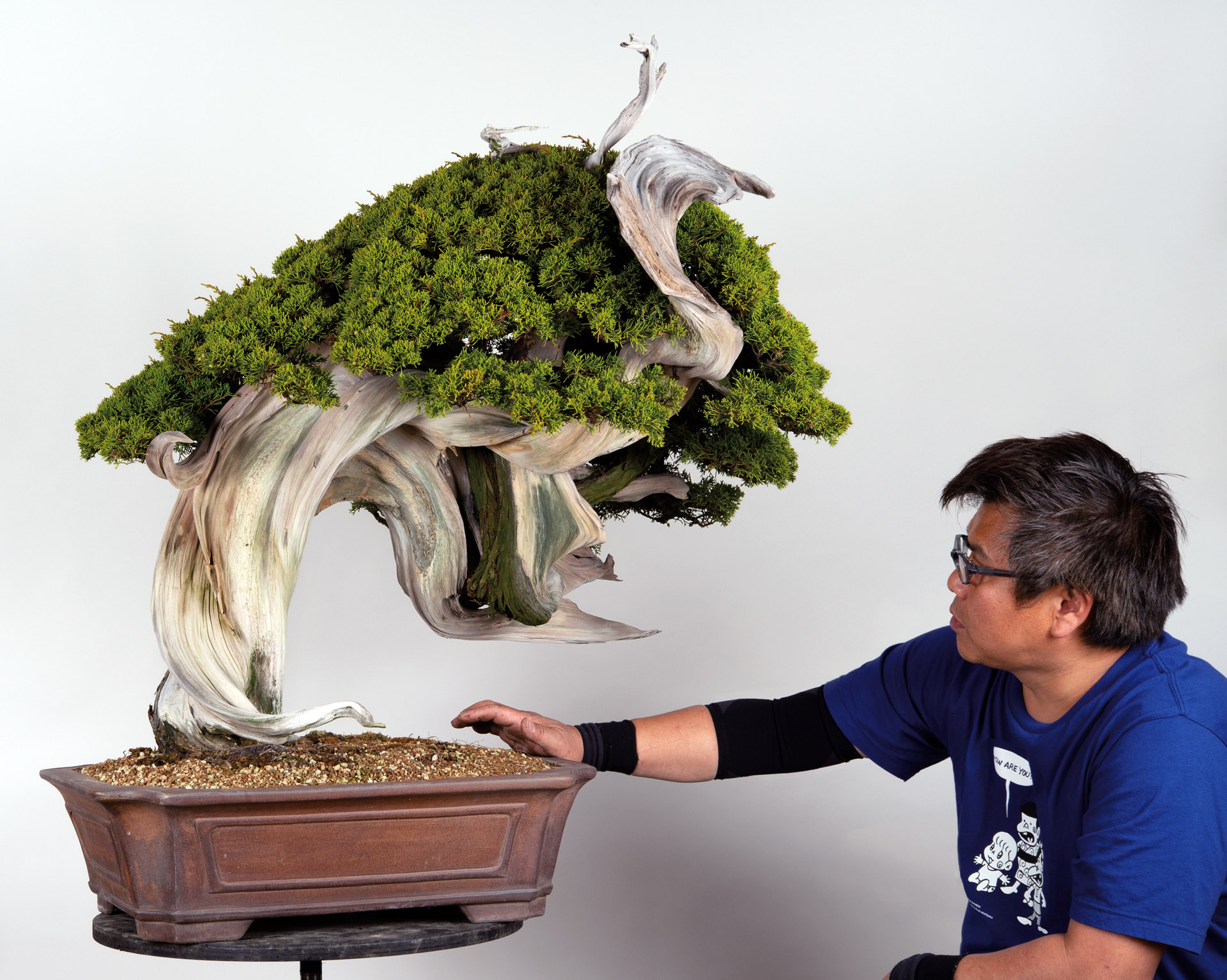
Masayuki Fujikawa takes things further by transforming a masterpiece
It is said that a tree displayed at Kokufu has reached a point of completion in a long journey. As the tree grows, finds a new owner, or an artist to care for it, the viewpoint of the tree will gradually change over time. For the bonsai professional who has a tree entrusted to him by a client, it is their job to make the very best out of the tree. Here we will see the transformation of a juniper that had reached a stage of completion when it was displayed at the Kokufu-ten.


- Date of work: 25th October 2020. Front before work. The pot is different from the one it was displayed in at the 93rd Kokufu-ten in 2019, but the shape is almost identical. Height: 84 cm Width: 90 cm Pot: Japanese rectangle. Owner: Mr Oizumi Zenrou of Sendai City, Miyagi Pref.
- Previous front. The shari in the lower trunk is wide and powerful. Unfortunately, no live vein is visible from the front.
Searching for the live vein in the lower trunk
Before work begins, Masayuki Fujikawa describes the front. ‘Natural deadwood is superb, and takes priority along with the direction of the thick trunk. Branches are skilfully managed and arranged to create a tree that is well worthy of being called finished and of a quality to be displayed at the Kokufu-ten. However, the owner entrusted me to make the most of the tree. After we consulted he left all the decisions up to me and so I examined the tree again, reconsidering the front. As it stands, there is no live vein visible from the front and so there is no variation in colour or texture, I am therefore going to look for the live vein.’
Although the tree has been ‘finished’ to the level of Kokufu, its journey still has a long way to go as a bonsai.
Superb deadwood, but it lacks variation and there is no live vein…
 Superb deadwood, but it lacks variation and there is no live vein…
Front and angle change


- A new front and angle has already been considered by Masayuki who rotates the trunk in a clockwise direction and also inclines it severely to the right
- This will be the new front and angle. The base of the trunk has become thinner, but the live vein is visible at the base and along the trunk.
Repotting at the new angle

The root on the left-hand side will be exposed at the new angle and so it is carefully broken down.
The same is done on the lower right side in order to facilitate the new planting angle.


After checking the new angle and front, the tree is firmly seated on the soil and tied down. Fresh soil is worked in around the root ball to ensure there are no gaps.
The transformation is nearly finished
As repotting is finished, Masayuki tells us ‘transformation, too, is now about 80% completed,’ about which we were very surprised, expecting to see much more of a dramatic transformation. Masayuki sensed our disappointment and so he reassured us that there is some branch removal and wiring necessary, but the point he is trying to make is that the pivotal thing for the transformation is the change in planting angle and front. We should have realised transforming a tree of this value and age is incredibly brave, and to have done something extremely different just for the sake of being able to do it, would have been egotistical and rather stupid. So, now on to the branch removal.

New front after transplanting. The foliage pads and branches are pretty much the same as they were when the tree was displayed at Kokufu, although they have grown out a little and some of the spaces between the pads have disappeared. There is a need to thin out some of the branches and more than anything else, the branches must be reoriented at the new planting angle.
Bold removal of branches
As a result of the angle change, the branches will need to be reoriented and rearranged. In order to do that, space between the branches must be made and the number of branches thinned out. In addition to this, the trunk movement is being hidden by too many branches at the new front.
Without hesitation, the branches are thinned out dramatically; however, it doesn’t appear that way, indicating how many branches were there to begin with.


- Holding scissors and branch cutters, Masayuki sets about thinning out the branches.
- The right side before branch removal
- The right side after branch removal.

Front after branch thinning. A large number of branches have been removed and we can see through the tree. The lower branch will surely be raised up at this new angle.
Before and after of the apex and lower branch.


- The lowest branch is very full and forms one continuous pad.
- The lower branches are now distinct pads after branch removal.
- The apex is overgrown and luxuriant before branch removal.
- The apex with evidence of the fresh branch removal visible.

The wiring proceeds at a very quick pace
Once all the wiring is finished, the lower branch is raised up even further using a piece of rebar so it attains the perfect position Masayuki desires.


Seen from the right after raising the lower branch.
Lifting up the lower branches
The lower branches need to be rearranged and reoriented at the new angle, as well as to complement the new trunk line. The lowest branch needs lifting up with wire and a piece of rebar out of the back, both of which are Masayuki’s forte. Though he said that the angle change was 80% of the transformation, there is still work to be done. Masayuki is very particular about the placement of the lowest cascading branch and demonstrates his uncompromising nature in the arrangement of the foliage pads. The photograph here is the final one we took on that day, but Masayuki was not happy with it. ‘Please wait until the tree turns green again for the final picture.’ There was something that didn’t sit right with him.

Final picture taken on the 26th October 2020. But there’s a problem with finishing the transformation here. Is it the foliage colour, presence of a rebar, or just more readjustment of the lowest pad?
Final styling of apex and branch


- The final styling of the apex.
- Also on the lowest branch. There is something small still disturbing Masayuki.

The foliage had turned brown over the winter, but we still took a picture late in December and sure enough the lower branch has been worked on.
The situation on 31st July 2021


- The foliage has now returned to green Height: 91 cm Width: 72 cm Pot: Japanese square.
- Lower trunk.


- After changing the planting angle last year, the front and the angle needs to be slightly changed again.
- There is a subtle change in the lower trunk.

Final shape (pot is CG). Just a small rotation and change of angle has made a huge difference, along with a slight reworking of the cascade branch. We hope you can understand Masayuki’s determination to achieve the best result from these changes.


