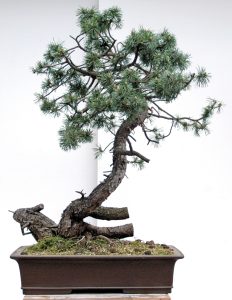
François Jeker analyses Richard Fels's boxwood
Details
- Boxwood. Buxus sempervirens
- Owner: Richard Fels
- Yamadori collected in the Corbières (Southern France) in 2011.
- Height: 70 cm / 27½”
- Width: 70 cm / 27½”
- Trunk diameter: 18 cm / 7″
- Estimated age: 200 years old
Analysis
Boxwood (Buxus sempervirens) in general, and especially these yamadori from southern France, are one the species most suitable for bonsai in Europe; their hard dense wood allows the creation of very fine and detailed deadwood features. The evergreen leaves are naturally small. The beautiful bark has a beige colour. And, normally, buds sprout easily on old wood. These shrubs are reacting very well to severe pruning, both on branches and on roots. They can reach a very great age.
This tree is almost a ready-made bonsai; a twisted trunk with deadwood areas and well ramified branches with good distribution. These branches are young and flexible enough to stand wiring. One problem, however, a back branch is too long and straight and is sucking out all the tree’s energy. This boxwood has a feminine feel to it, so it shall not have a dense green mass. The styling is going to be very easy.
A: Twisted trunk without any straight part. B: Powerful nebari.
Design
Boxwood is a slow grower in the wild. Under very good conditions, it takes twenty years to gain 1 cm / about ½” of trunk thickness! In harsh conditions and in the mountains, it will take 3 or 4 times longer to gain the same thickness. In a pot, the trunks of these yamadori will not grow any further, but with good pruning technique, the boxwood can develop consistent branches with good ramification.
Over the first years, let them grow freely until September and then cut back to 2 leaves. After 4 or 5 years, cut back the stronger shoots to 2 leaves in June, then in September, cut back the weaker ones. You must balance the apical dominance. Spring pinching can be performed only on mature bonsai and never more than two years in a row. The leaves of boxwood like to be wet and they appreciate organic foliage fertilizers.
Aesthetic choices
The selection of the front was obvious; that angle of the trunk movement is the more interesting, especially the visual bend on the left, at two thirds of the tree’s height. On that side, deadwood is well visible and the base also seems larger. The apex was positioned above the base with a short, rounded green mass, many empty spaces were positioned on the left and on the right, and it has a slightly pointed silhouette.
The first left branch seems to disobey bonsai rules; its ‘armpit’ is on the right, but then it comes back towards the left and crosses the trunk.
John Naka once said to me: ‘If you must choose between the Japanese rules of bonsai and enhancing the work of nature, always go for nature.’
‘If you must choose between the Japanese rules of bonsai or enhancing the work of nature, always go for nature.’
John Naka

'If you must choose between the Japanese rules of bonsai or enhancing the work of nature, always go for nature.'
John Naka