A powerful Taxus

François Jeker analyses David Molin's Taxus baccata

Yew (Taxus) is a very common material for creating spectacular bonsai. Its red flaking bark, tiny foliage and rapid growth make it popular among creative bonsai enthusiasts.

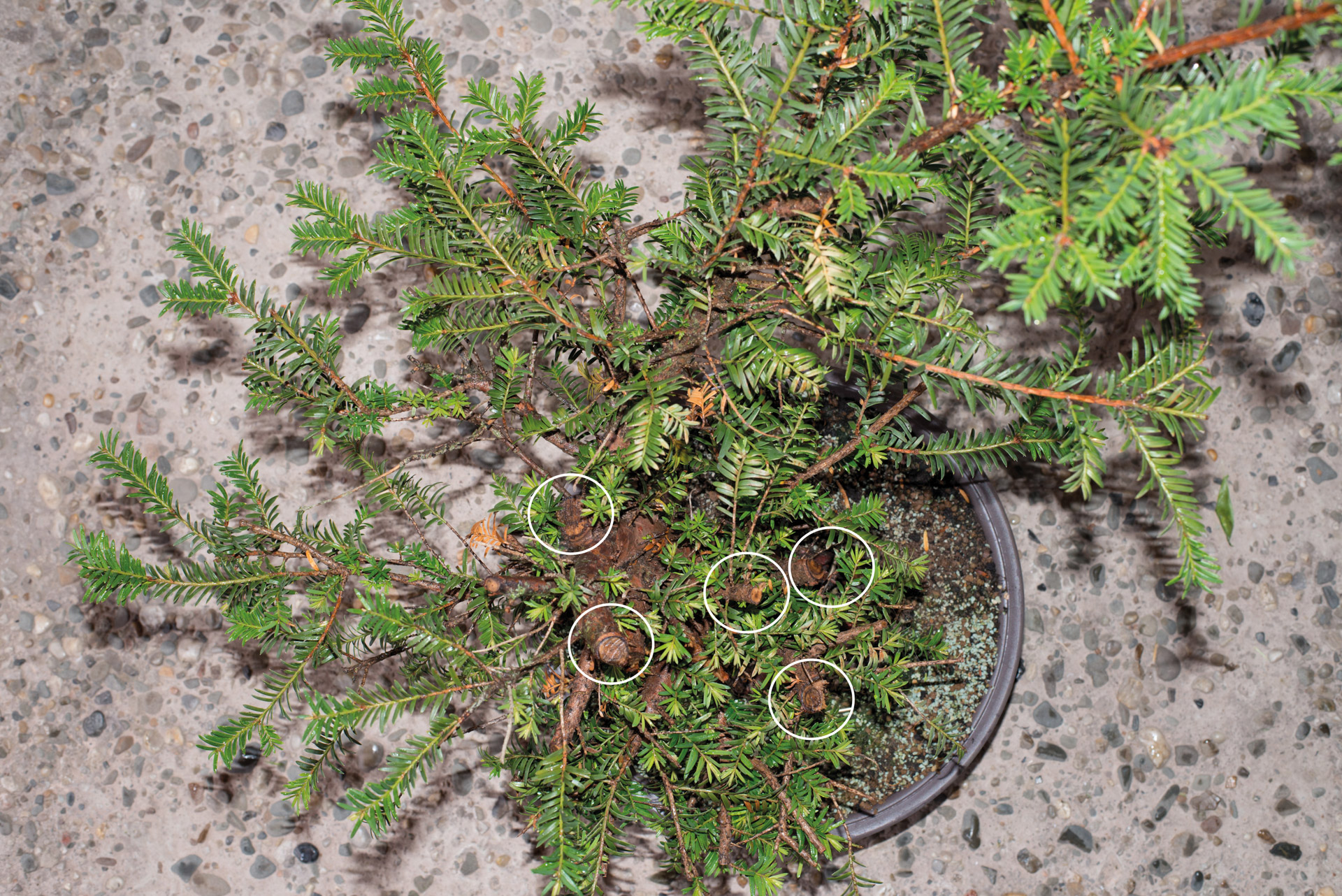
Yews belong in the group of trees whose branches should be styled when young. Older branches break easily and do not grow rapidly. Yews react very well to severe pruning which induces lots of new shoots on old wood. This greatly helps further styling. Deadwood styling is easier on living sapwood, more difficult on heartwood, which is much harder and no longer fibrous. You can recognize it by its reddish-brown colour, whereas the sapwood is almost white and still fibrous.

Analysis

This yew is interesting despite some drawbacks: it is too high, and its thin diameter gives it a very fragile aspect. The ratio height/nebari is 12! According to John Naka, the maximum ratio should be 6 . . .The nebari is too prominent on the right, and the higher part of the trunk shows large scars, which would be extremely hard to hide. Despite this,.severe pruning will reveal the potential of the tree and allow it to become a classic and powerful bonsai.

Details

Yew (Taxus baccata)
Origin: nursery stock
Estimated age: around 20 years
Owner: David Molin
Height: 75 cm / 29½"
Trunk diameter: 6 cm / 2¼"

Asymmetric nebari: The tree will have to be tilted to the right

Future top: Taper will be perfect

Large scars that will be difficult to correct. The top will be ransformed into deadwood.

Working schedule during the first year:

Proceed to a drastic pruning, keeping only the young flexible branches. Also proceed to the first stage of the deadwood styling: peel off the bark (avoid leaving marks on the exposed wood), and peel fibres of living wood to show the line of the veins. The tenjin is wired to create movement.

During the second year:

Repot to change the planting angle, lower the branches with guy wires, to harmonize their angles. After the first severe pruning, it is essential to let the tree grow freely, without further pruning, for two years. During the third year, select the useful branches, wire and style them. During the fourth year, the tree must grow freely, for the branches to thicken and retain the form given by the first styling.

Change of planting angle.
Left: Outline of the tree after severe pruning and work on deadwood.
Right: Outline after changing the planting angle towards the right and lowering the branches Top is wired and moved to the left.

Aesthetical choices

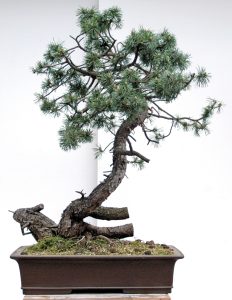
The ratio nebari/height is now 1.8. The tree has become very powerful, with a large trunk and a balanced nebari. The movement to the right given by the tenjin is emphasized by the dense rounded vegetation pads on the left, and the sparser, sharper pads on the right, separated by larger empty spaces. The tree is planted in a sober, light reddish brown unglazed pot.

© 2026 All Rights Reserved

Send me the newsletter.

You can cancel your Bonsai Today membership at any time, and you will continue to have access to Bonsai Today through the end of your billing period.  To cancel, go to the ‘Members‘ page and click on ‘Cancel‘ in My Memberships.