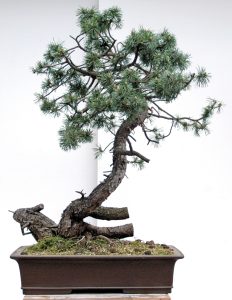
François Jeker analyses the larch of Didier Weiss.
European larch
The larch (Larix decidua) has a special place in the world of bonsai. In spring, it produces vibrant green opening buds and offers golden yellow autumn colours, but the best season for a larch is winter without its needles. Then, the tree is at its most vulnerable and reveals its soul.
That means that you can’t cheat with a larch, because one can see it immediately. That is why larches require the utmost thoroughness in the styling process.
European Larch (Larix decidua)
Owner: Didier Weiss
Yamadori collected in the French Alps, 2014.
Height: 70 cm / 27½”
Trunk diameter: 11 cm / 4¼”
Estimated age: 60 years
Analysis
At the moment, this tree is too well behaved, too ordinary. Maybe too much! The trunk shows little strong movement, has a light taper and many long branches. These are the features of a calm, low altitude tree.
It is, however, a tree collected from the mountain heights. To get the most from its potential, you need to eliminate long branches, create a tenjin, select a lower and well-ramified branch to create a new apex and give more movement, taper, compactness, and avoid its present ‘good boy’ appearance.

A: Future deadwood
B: Future apex


A: Jin – B: Apex – C: Balance branch – D: First branch
Aesthetic choices
As the tree has been reduced in height, the trunk appears more powerful. The downwards angle of the selected branch, which became the new apex, and the powerful jin pointing to the sky are creating a strong graphic break, and they also give this larch an energetic movement. Please note that if the trunk is left oriented, the green masses are mostly towards the right. Therefore, the beauty of this bonsai increases in elegance and movement.

The ideal pot will be as discreet as possible: same colour as the bark and extreme simplicity in its shape in order to obtain a strong contrast with the tree’s movement.