In this chapter we’ll look at the aesthetics of bonsai design. You first need to realise that symmetry stands for ‘man made’ and that a-symmetry symbolises ‘nature’. Trees in nature are not symmetrical, so bonsai should also reflect that in their designs. A bonsai is not an exact copy of a tree in nature. The complexity of nature is simplified, minimised and stylised, resulting in a clear understandable layout of trunk and branches. The principle of simplification has its roots in Zen Buddhism.
Bonsai is a composition in which its trunk and branches play an important role in the expression of a tree. The choice and placement of the branches is made according to a well thought out plan. Open spaces between the branches serve as a tool to create a balanced and dynamic branch setting. For example, parts of the trunk, like a gangling curve or an interesting hollow not concealed by branches, will have open spaces around them. With such open spaces you can highlight certain parts of your bonsai creation.
Here is a twin trunk style Buxus by Alain Arnaud. No branches cover the lower part of the trunk with the beautiful deadwood. The open spaces between the branches create interesting layers of foliage and engender a feeling of depth. Note that the branch setting is not symmetrical, the left and right parts of the tree are quite different.
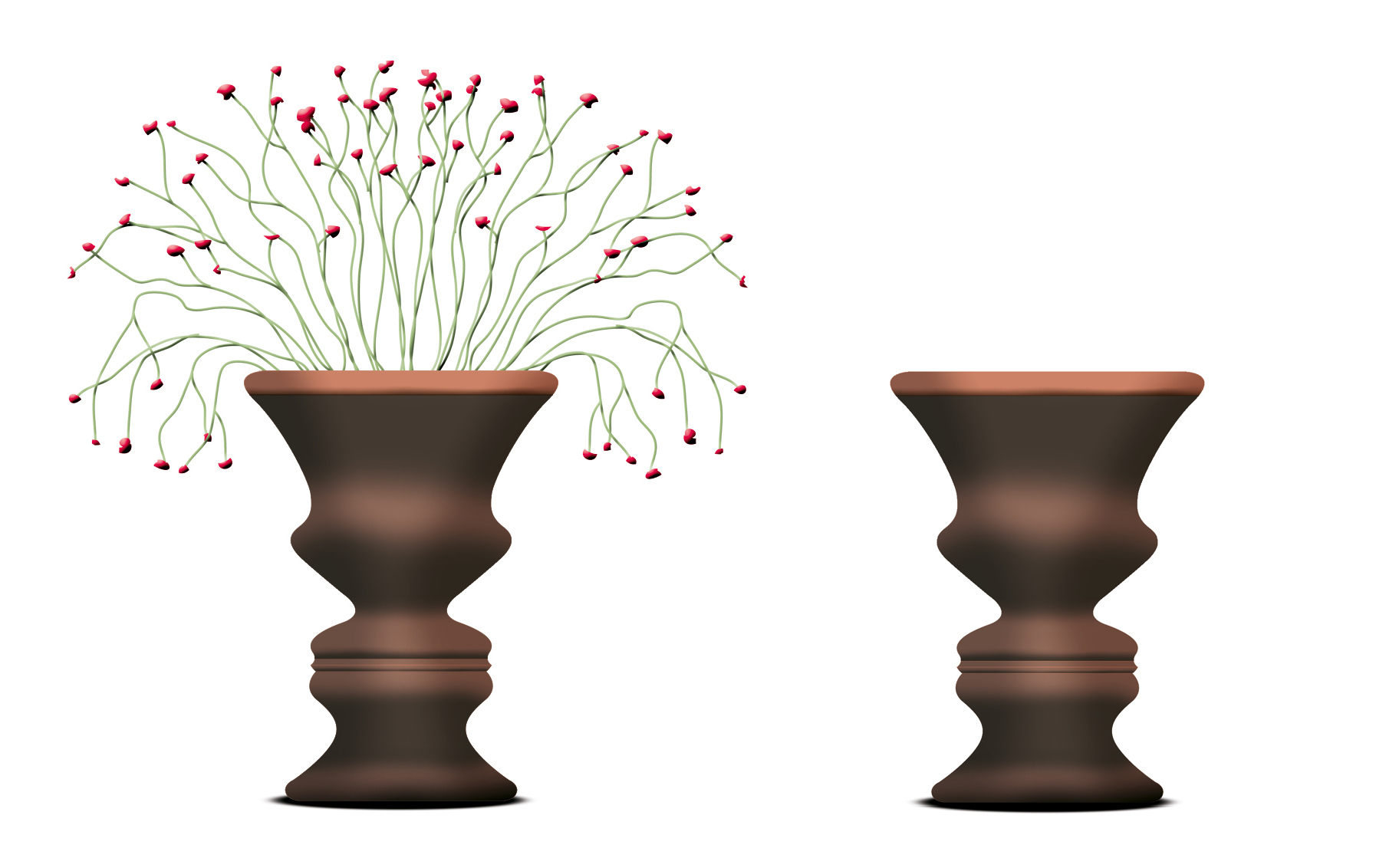
This Tuscan vase serves as an exercise for looking at things differently. Your left brain enables you to have a global vision of the object: the vase, the flowers, the harmony of the unit are pleasing. Now disregard the flowers and concentrate only on the pottery — what do you see now?
The left and right sides of your brain see things differently
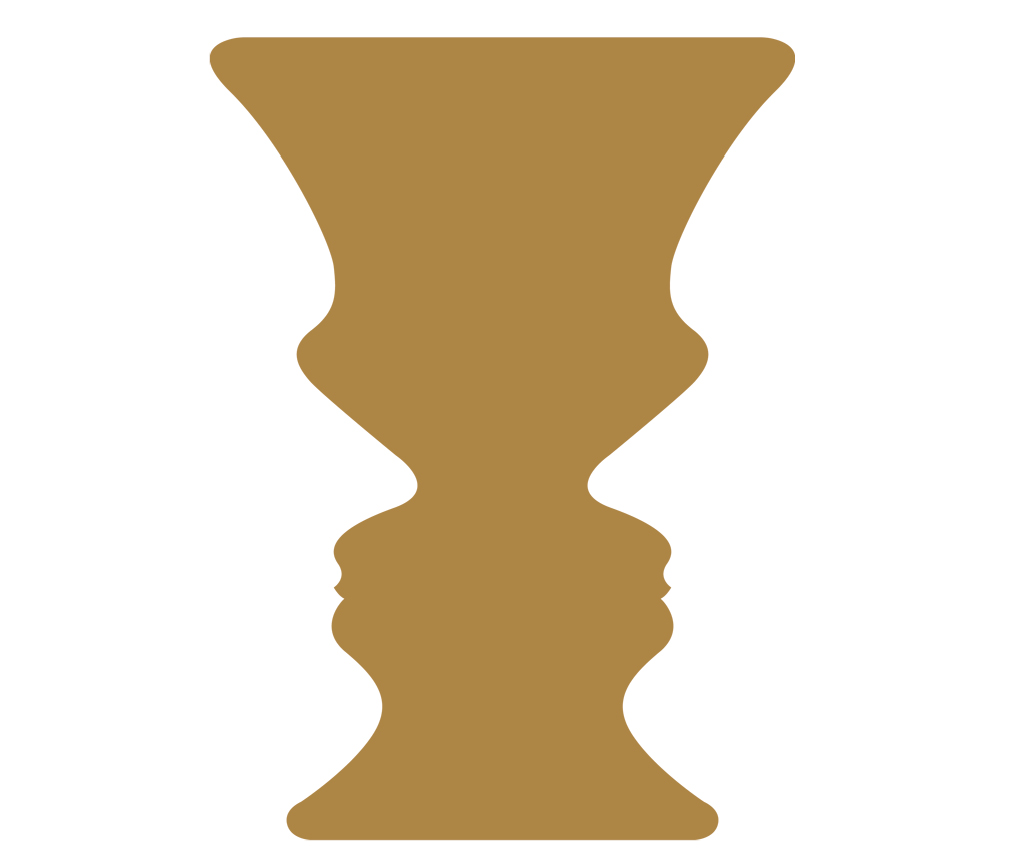
If you look attentively at the vase you will see that it offers several visual alternatives. The first, in the left hand illustration, is the actual object. It is solid. It is full. If you run your hand up the outside of the vase it is actually there. On the other hand, consider that on the outside of the vase is empty space without the limit of its contour. If you pass your hand over the edges of the vase it will undulate along these empty spaces. If you draw your hand away from the vase, it will be in a vacuum. Your left brain analysed the situation. It submitted a report to you on the material reality of the object itself.
Let’s go further . . .
Forget the solid object and look only at the empty spaces. You’ll find it surprising. Where there was a vase you have two faces looking at one another! Your right brain has just analysed empty spaces and it discovered hidden forms. First of all the left brain does not work much whereas it is hyper active in the artists. Therefore, you must make your left brain work, involved it. Every day try to see the empty spaces created by your bonsai. Look at nature with a different eye. Lastly, turn a little towards such arts as painting or the sculpture to stimulate the imagination.
Spaces between branches and around the trunk are very important design tools…
3 July 2024
We use cookies on our website to give you the most relevant experience by remembering your preferences and repeat visits. By clicking “Accept”, you consent to the use of ALL the cookies.
This website uses cookies to improve your experience while you navigate through the website. Out of these cookies, the cookies that are categorized as necessary are stored on your browser as they are essential for the working of basic functionalities of the website. We also use third-party cookies that help us analyze and understand how you use this website. These cookies will be stored in your browser only with your consent. You also have the option to opt-out of these cookies. But opting out of some of these cookies may have an effect on your browsing experience.
Necessary cookies are absolutely essential for the website to function properly. This category only includes cookies that ensures basic functionalities and security features of the website. These cookies do not store any personal information.
Any cookies that may not be particularly necessary for the website to function and is used specifically to collect user personal data via analytics, ads, other embedded contents are termed as non-necessary cookies. It is mandatory to procure user consent prior to running these cookies on your website.
Send me the newsletter.
You can cancel your Bonsai Today membership at any time, and you will continue to have access to Bonsai Today through the end of your billing period. To cancel, go to the ‘Members‘ page and click on ‘Cancel‘ in My Memberships.