


The growth will slow down then stop by the end of the month
The roots reach a maximum stage of development.

Needs of the tree
Less food, but more elements specific for lignification. Spring pinching (metsumi); defoliation; fertilising; candle pinch pines to balance them. Water every day.

Placement
Maximum development of the small branches. The foliar mass is at its maximum. The tree has just accumulated plenty of reserves.

Fertilizing
Until the end of the month apply lots of fertiliser on the trees in growth. At the end of the month you can neutralise the substrata with a solution of ashes in water.
Watering
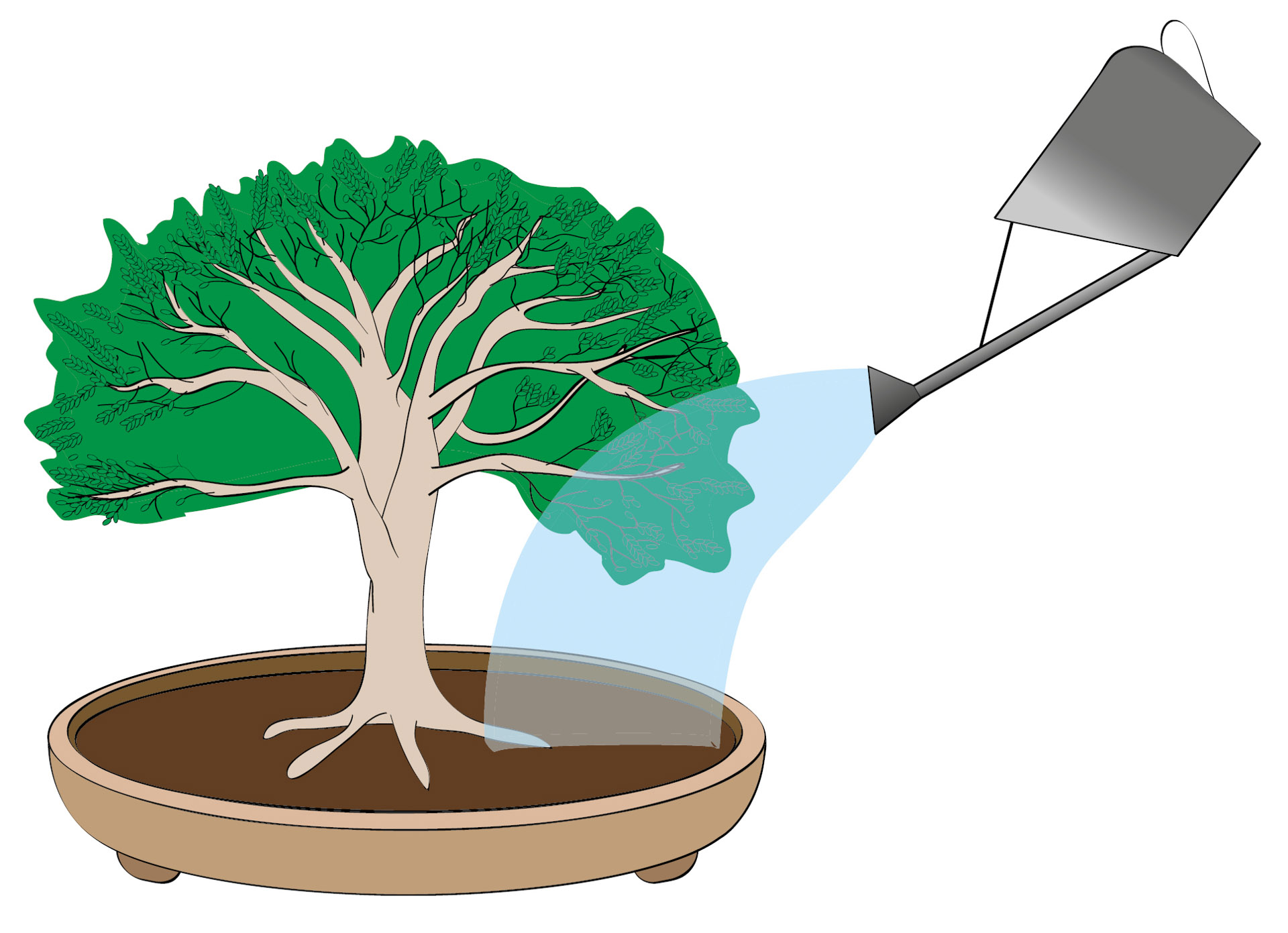
Water all the trees every day and give plenty of water each time. The pots of willows will need to sit in water at each watering.

Treatment
Caution — red spiders (acarina) are possible The leaves seem grey. Use specific insecticides.
Activities
- Wire: check earlier wiring and remove it — particularly on maples — because it can deeply mark the bark. It’s not really dangerous because the marks disappear with some treatment and the passing of the years.
- Leafy trees: Pinch mature trees whose small branches have grown well and begin their lignification. The strength of the tree is balanced in this way. Possible defoliation.
- Azaleas: after removing the flowers (they are removed when 70 % of flowering has occurred) pinch the new small branches. Where there was a flower there will be a group of small branches. Leave only two. You can carry out drastic pruning on the large branches. In this case, cut into them several times. Notch severely and a month later cut off completely. That avoids sap withdrawal and allows good budding on naked wood.
- Beech: these are not currently defoliated, but you can reduce their leaves by cutting them off. The benefit of this technique, used only on immature trees, is to facilitate light and air flow at the centre of the tree, thereby supporting future back budding. The defoliation of the beech is not recommended by the Japanese, however our Fagus sylvatica supports it very well.
- Japanese black pine: where you pinched last month quantities of new buds have emerged. Select them in pairs. Remove the buds directed upwards, towards the base and those that are very weak. Leave two buds of identical size.
- Yews: prune the tips of the strong small branches. You will obtain a budding at the place of the section. So, if at the same time you defoliate the branch, you will cause back budding on stripped wood with the proviso that you retain some leaves to allow sap to run to the tips of the branches.
- Tropical bonsai: you can leave them outdoors. Full sun for all, but only gradually so as not to burn the tender leaves. Much water and nitrogenous fertiliser. All tasks are allowed.
- Hornbeam: possible defoliation.


