
Fertilising

There are two kinds of fertiliser

  • Organic fertilisers with a deferred action that’s slower
  • Chemical fertilisers are immediately absorbed by the tree

Organic

It is better to use organic fertilisation, since it’s less dangerous. Their action is more durable, softer. Furthermore, they improve the holding capacity of nutritive elements in the substrata, make it more flexible, increasing its biological activity. Indeed organic fertilisers are not absorbed by the rootlets just as they are. They must initially undergo a microbial degradation. This produces humic acids that, once degradation is complete, will be absorbed. 
Therefore, you see that it is imperative to have a microbial flora in the soil. This flora arrives by itself, but you can introduce it by adding humus-producing substances — either in liquid form or as solids in the form of well-decomposed composts. You can use them by covering the soil mix with them, or by mixing them with water (3 parts to 7 of water) and sprinkling over the surface before adding organic fertiliser pellets.

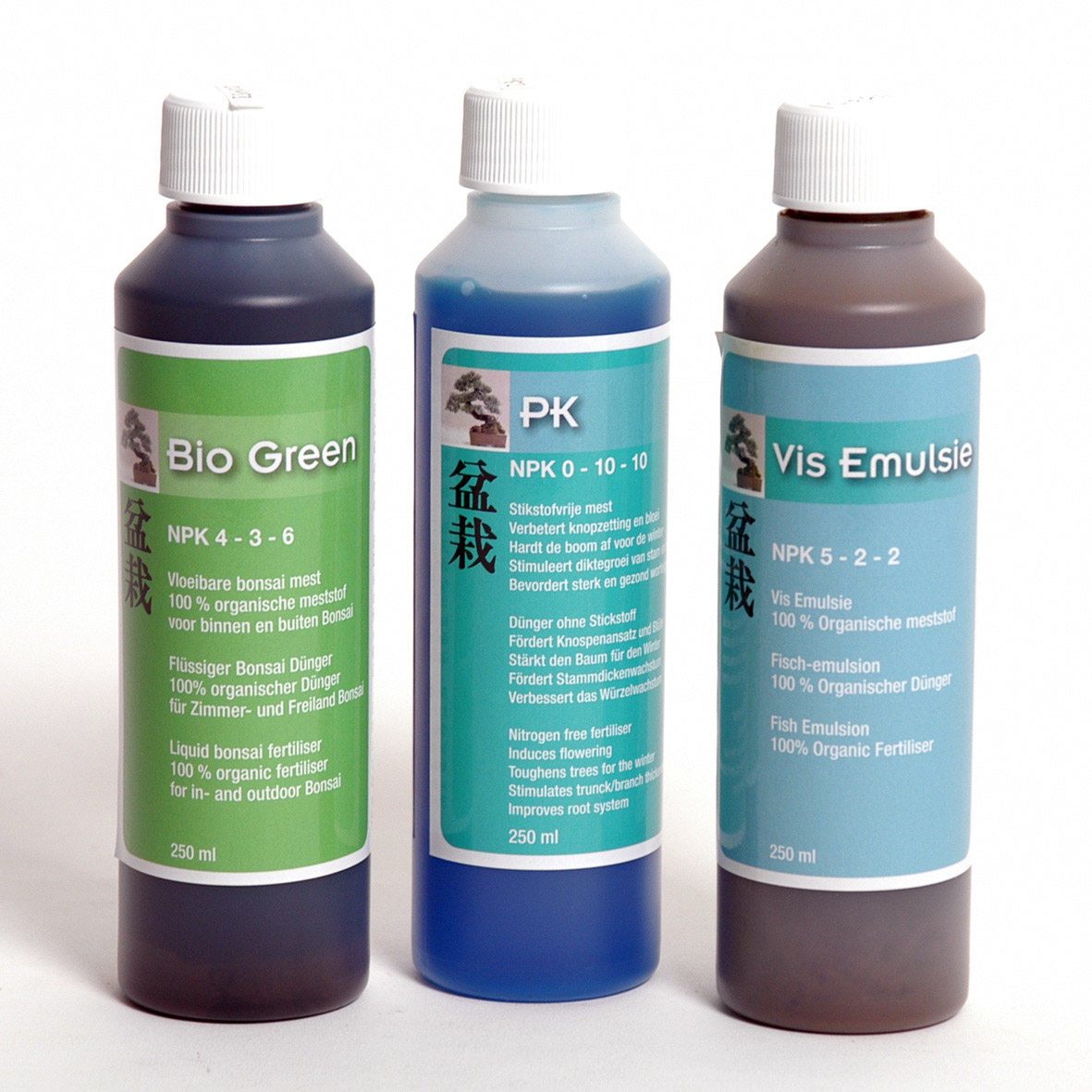
You will understand that this fertilisation will acidify the soil. It will therefore have to be neutralised from time to time — in late spring and also as autumn finishes (see beneath). For good organic fertilisation you can use pellets of fish or meat meal and soya bean oil cake used in the proportions of 2 – 8 to 3 – 7. In spring it is necessary to force on the Fish emulsion.

Chemical

Chemical fertilisers are much faster, sometimes instantaneous, but they burn and impoverish the soil mix. You can use them, but just in quite specific cases when, for example, you want to accelerate growth. It’s always necessary to sprinkle this type of fertiliser to avoid burning the roots.

In practice

At nurseries and garden centres, you will find an impressive array of pellets adapted for every season — even for individual species of tree. Go and take a look, but remember that trees need three specific elements.

N = Nitrogen: the growth promoter. Young trees need this in great quantities in the spring, and then in very limited amounts until autumn. 
P = Phosphorus: promotes the growth of roots.
K = Potassium: Improves resistance to diseases of the tree which makes it possible to accumulate reserves. Useful for flowering and fruiting.

Note

Substrates such as akadama, kiryu and pumice are usually sterile, which makes fertilizing necessary. Even a substratum containing compost requires fertilising because, thanks to watering, it quickly becomes impoverished.

Neutralising the soil

1 part of wood ash to 9 parts of water.
Allow to settle and then sprinkle.

The more you fertilise, the more the medium is acidified. A very acid medium slows down the assimilation of the fertiliser. Therefore, it could be neutralised at the end of spring and/or of autumn to rebalance it.

To neutralise the soil medium sprinkle with the ash and water mixture.

When to fertilise

  • In general, you can give more nitrogen in spring, and more phosphorus and potassium in autumn. 
  • Fertilisation must be adapted according to the season and the stage of cultivation the trees have reached. 
  • Do not fertilise in winter because the trees are in dormancy and their rootlets won’t absorb fertiliser. 
  • Indoor bonsai can be fertilised more or less all the year round. 
  • If you apply a chemical fertiliser, do not do so at the end of autumn because its over brutal action would make the plant suffer just before its dormancy.
  • When you repot you can put in organic fertiliser in pellet form. It will degrade and be transformed into humic acid in 15 – 21 days. At this time, new rootlets will exist so don’t risk anything more. In any case, don’t apply chemical fertilisers. You can use the liquid organic fertiliser. In this case it should be used either once per week or every 15 days. Be careful with it. 
  • Do not fertilise sick bonsai or those receiving treatment.

Various kinds of fertiliser

There are many ready-to-use fertilisers available that are suitable for bonsai. Here are some examples, but it is best to ask your local bonsai nursery which fertiliser is best to use for your particular bonsai.

Bio gold a well known Japanese brand in the form of pellets. It comes in bags and cans as shown here. These can be diluted in water if you prefer a liquid fertiliser, which is less messy than pellets.
Japanese pellets are a slow release organic fertiliser that can be used for all bonsai during summer.
Suitable for fertilising in spring, Biogold liquid fertiliser can be used for all bonsai.
Rainbow liquid vitamins — not a fertiliser, but a liquid form of vitamins. It can be used for weak bonsai or just after repotting to help revitalisation.
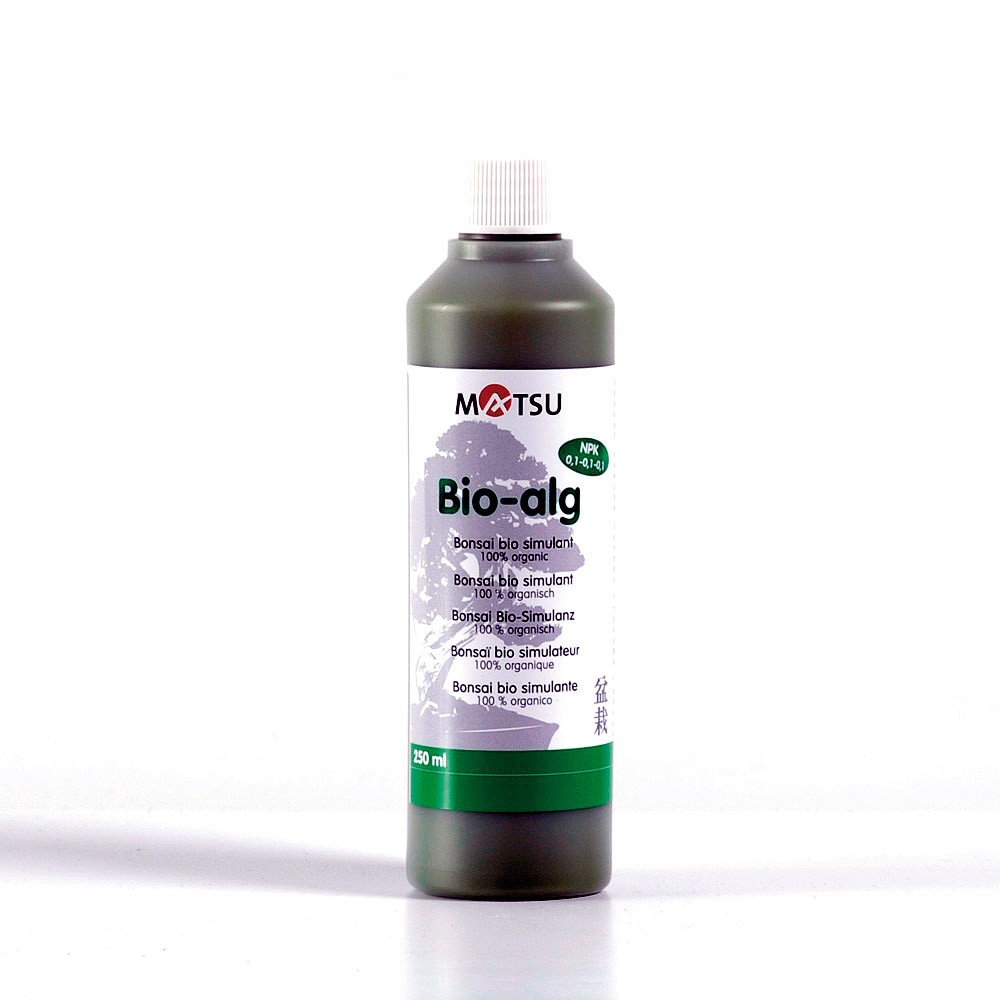
Matsu has a large range of helpful additional elements for resistance to for fungal attacks, to stimulate flower buds, or to help give bonsai a boost before winter.
Bio Alg Bio-alg is a 100% organic bio stimulant that can be applied in combination with other bonsai fertilizers. Produced from 100% seaweed.

Annual fertilisation schedule

January – Nothing!

February – If necessary, spray on a prophylactic treatment of sulphur + copper. Spray the trunks and branches with trace elements Ca; Fe; Cu (every 15 days).

March – Spray the trunks and branches with trace elements Ca; Fe; Cu (every 15days).

At the end of March, start organic fertilisation.

Young bonsai: fertilise with higher level of nitrogen (N higher than P and K). – Mature Bonsai: either apply nothing at all, or a balanced and weak

NPK (lower than 6).

April – If you use organic fertiliser pellets, make sure they degrade well. It is necessary to change them as soon as they have disintegrated. Adopt the same principle of fertilisation as described above. The more you use pellets, the more it’s necessary to water.
You can always spray solutions of trace elements on the foliage, once a week.

May – As April

June – As April. At the end of the month neutralise the soil mix with water + ashes.

July – If you water often, or if it rains, you can fertilise as in the spring, but in lesser amounts. Otherwise, remove the pellets, but spray the leaves with trace elements.

August –  As July

September – Autumn fertilisation. P and K much higher than N (which can remain present, or not). It’s necessary to continue fertilising while the plant is still active, and so long as leaves remain. At the end of month neutralise the soil mix with water + ashes.

October – As september, except for neutralization.

November – As september, except for neutralization.

December – Nothing, except perhaps spraying a sulphur + copper treatment, if necessary.

© 2026 All Rights Reserved

Send me the newsletter.

You can cancel your Bonsai Today membership at any time, and you will continue to have access to Bonsai Today through the end of your billing period.  To cancel, go to the ‘Members‘ page and click on ‘Cancel‘ in My Memberships.