
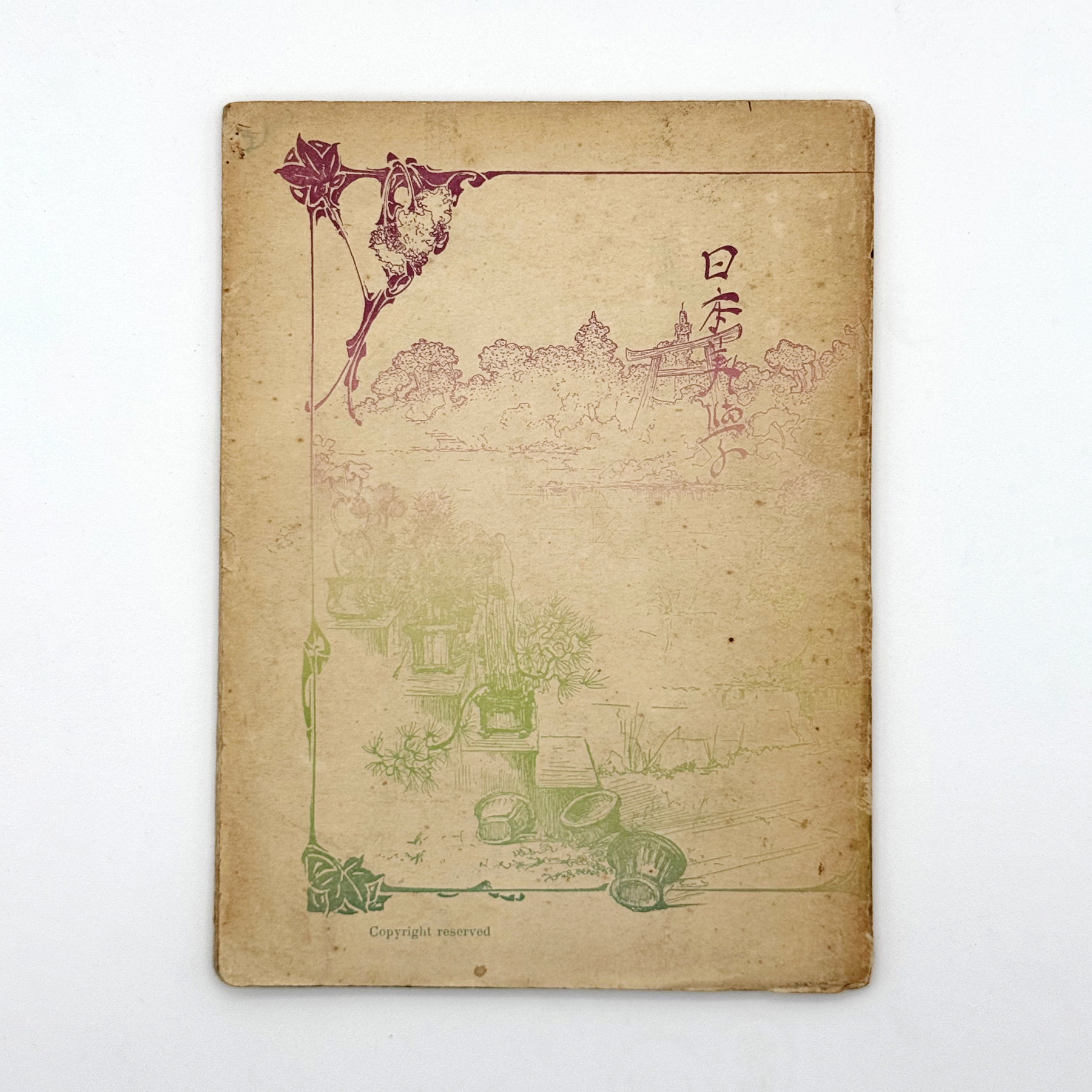
A collector's item is auctioned.
We believe you will be interested to learn that the first book written in the West exclusively dedicated to the art of bonsai, published in Paris in 1902, is now available for auction.
An important reason why this item caught our attention is the name of the illustrator of the cover of this book, Moïse Marcel Bloch.
Bloch is not an unknown name in the Bonsai World. Farrand Bloch is editor-in-chief of the successive magazines Bonsai Europe and Bonsai Focus for more than 25 years.
The auction catalogue states the following about this unique book;
The first Western book on the millennial Sino-japanese art of bonsai, of which only six copies can be identified worldwide, with no record of any sales in recent decades. Although not completely unknown in Europe, the Japanese technique of arboreal miniaturisation had received only brief considerations in scattered accounts since the arrival of the Portuguese in Tanegashima in 1543, and until the first scientific articles published in France towards the end of the 19th century.


The reopening of Japan to the world, which intensified from the late 1850s, had an extraordinary cultural impact on the West, awakening and renewing an European and North American fascination with the Empire of the Rising Sun, which had diminished during more than two centuries of voluntary isolation (Sakoku).
This new gaze of great curiosity towards Japanese culture, especially in artistic and cultural circles that yearned for the new and for liberation from academicism, became obsessive to the point of influencing the visual arts and various aspects of European culture, even leading to the creation of the term japonisme to identify it.
Although a first attempt was made at the Weltausstellung Wien of 1873, it was at the third Exposition universelle in Paris, in 1878, that Japan would exhibit, for the first time in Europe and with a criterion of exclusivity, bonsai in its pavilion. In this context of wonderment and rediscovery, several texts on this art appeared, some of which were identified by the young author, who acknowledges that they helped him to elaborate the work.
However, it would be necessary to wait until 1902 for it to be completed and printed, emerging from the presses as the first book entirely dedicated to this fascinating practice that continues to captivate the Japanese and millions of people throughout the world.

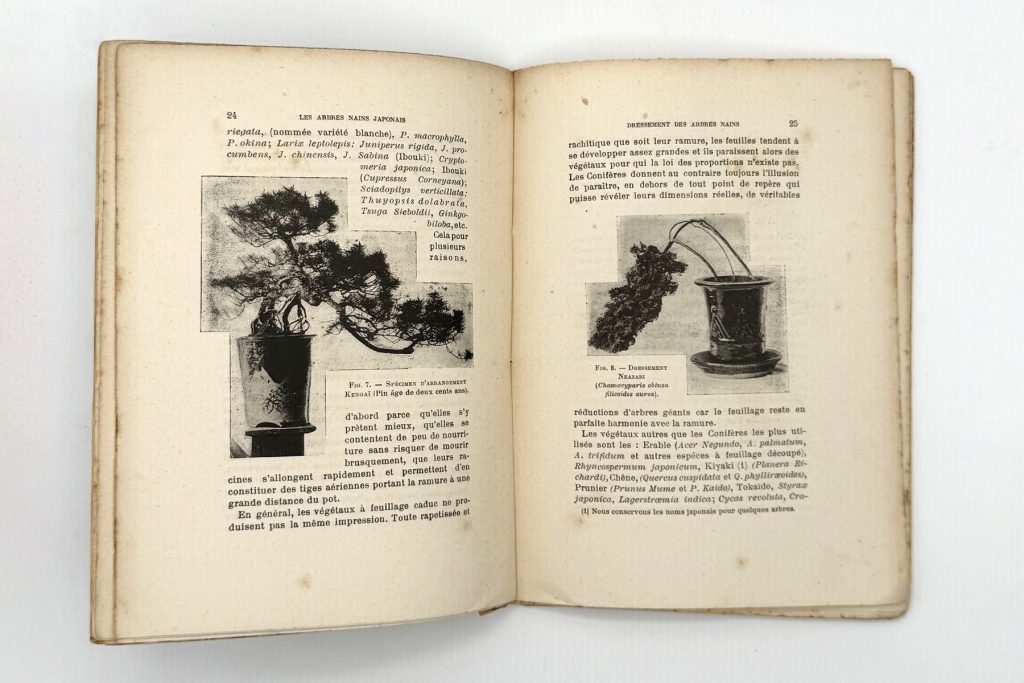
The original print run is unknown, but it was certainly very limited, as is customary for some Parisian publications of this period. The work is adorned with elegant black photogravures, both integrated within the text and presented on inserted plates. Albert Alexandre Léon Julien Maumené (1874–1963) was a French journalist who devoted a significant part of his career to writing and coordinating works on gardening, horticulture, and botany.
He was also a pioneer in flower photography and in the unusual practice of applying photography to fruit. He also wrote about some aspects of traditional French culture, such as furniture. Born in Breteuil, in the Oise, on 16th January 1874, he lived a long life, passing away in Paris on 2nd June 1963.
The beautiful Art Nouveau cover is signed by the painter of Jewish origin Moïse Marcel Bloch (1882–1966), who was only 19 years old at the time. The use of Japoniste imagery reveals great sensitivity to and knowledge of Japanese culture, as seen in the inclusion of kanji characters (“The Art [or Technique] of Bonsai” on the front cover and “Japanese Bonsai” on the back). Bloch would go on to have a highly successful career, developing in the 1920s humorous, Art Deco-flavoured figures inspired by the eighteenth century, which became quite famous in France.
He was a member of the Salon des Indépendants, the Salon des Artistes Français, exhibited at the Salon des Humoristes, and was part of the committee of the Société des Dessinateurs Humoristes. He worked extensively in publishing, illustrating major works by both 19th-century and contemporary French authors (such as André Maurois), as well as school textbooks. No reference could be found to this intriguing early collaboration with Maumené, which makes this copy even more valuable. Bloch served in the Great War, and his name is inscribed in the Livre d’or des soldats de Verdun.

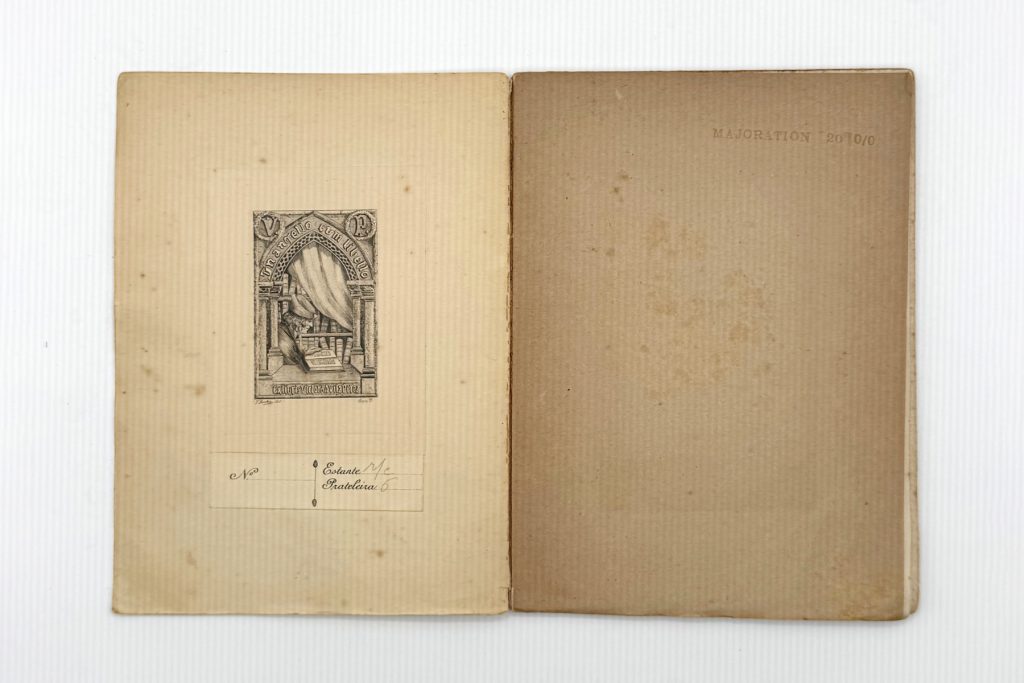
Thanks to the presence of his ex-libris and information from the current owner regarding previous provenance, we have been able to trace the journey of this extremely rare copy to the library of the Portuguese industrialist and great bibliophile Victor Marat d’Ávila Perez (1881–1968), one of the finest Portuguese libraries of the twentieth century, which was partially auctioned in 1939 and gave rise to a bibliographic catalogue of reference. The volume would later become part of the library of the Burnay Palace in Lisbon.
Collector’s item
The auction house claims”: “the copy is in good overall condition. Minor loss of material at the head and tail of the spine. Some fading to the wrappers and occasional, faint signs of foxing within.
You can start bidding here from @ € 50000

